$115,000 a Year After Tax in California
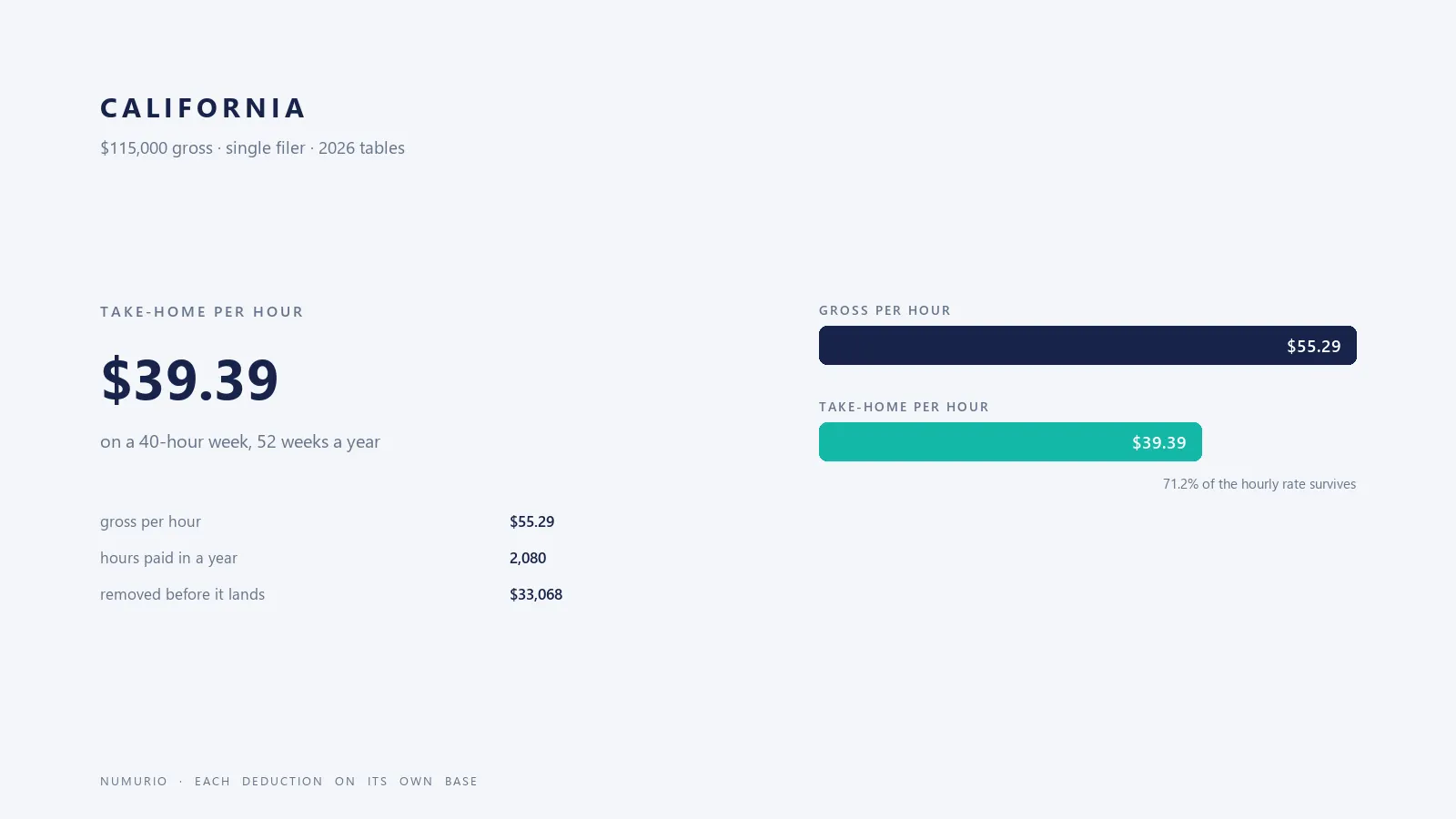
A single filer earning $115,000 in California takes home about $6,828 a month, or $81,932 a year, after federal income tax, FICA and state tax. The exact figure depends on filing status, 401(k) contributions and your city; adjust those below.
Adjust it to your situation
| Line item | Annual | Monthly |
|---|---|---|
| Gross pay | $115,000 | $9,583 |
| Pre-tax deductions (401k / HSA) | -$0 | -$0 |
| Federal income tax | -$16,470 | -$1,373 |
| Social Security | -$7,130 | -$594 |
| Medicare | -$1,668 | -$139 |
| California state income tax | -$6,306 | -$525 |
| Local / state payroll tax | -$1,495 | -$125 |
| Take-home pay | $81,932 | $6,828 |
- Federal income tax$16,47014.3%
- FICA (Social Security + Medicare)$8,7987.6%
- California income tax$6,3065.5%
- Local / state payroll tax$1,4951.3%
- Take-home pay$81,93271.2%
Where the $115,000 goes before it reaches your account
Three layers come off before the money reaches you. Federal income tax is progressive, so only the portion above each bracket threshold is taxed at that bracket's rate. FICA is flat: 6.2% for Social Security up to the annual wage base, and 1.45% for Medicare with no cap. Then California takes its own share.
California applies progressive brackets on top, so the same salary in a neighbouring state can land thousands of dollars apart over a year.
Single filer, standard deduction, nothing entered in the pre-tax boxes. The SDI levy at 1.3% is already in the figures above because it comes off every cheque in California. A city or county income tax is not in the dataset.
Every line of the calculation
The table below is the calculator's own output at the defaults just described, line for line. Each line multiplies a base by a rate, and every rate appears in the source list.
| Line | Annual | Monthly (12) | Semi-monthly (24) | Bi-weekly (26) | Weekly (52) |
|---|---|---|---|---|---|
| Gross pay | $115,000 | $9,583 | $4,792 | $4,423 | $2,212 |
| Pre-tax deductions (401k / HSA) | -$0 | -$0 | -$0 | -$0 | -$0 |
| Federal income tax | -$16,470 | -$1,373 | -$686 | -$633 | -$317 |
| Social Security | -$7,130 | -$594 | -$297 | -$274 | -$137 |
| Medicare | -$1,668 | -$139 | -$69 | -$64 | -$32 |
| California state income tax | -$6,306 | -$525 | -$263 | -$243 | -$121 |
| Local / state payroll tax | -$1,495 | -$125 | -$62 | -$58 | -$29 |
| Take-home pay | $81,932 | $6,828 | $3,414 | $3,151 | $1,576 |
Monthly, semi-monthly, bi-weekly and weekly columns are the annual amount divided by 12, 24, 26 and 52. Those are averages, not a payroll formula. Withholding happens per cheque, not per year: the IRS percentage method is applied each period, so a bonus can take more than this average and hand it back at filing. Once gross pay passes the Social Security wage base, the 6.2% portion stops and later cheques rise.
Married, filing jointly, on the same salary
Everything so far has been a single filer. On a joint return with this $115,000 as the household's only income, the standard deduction is twice as large and every federal band is twice as wide, which leaves $10,332 more in the year. Most of the gap comes from the federal side; some states widen their own brackets for joint filers too, which is why this is computed from the real California table rather than assumed.
| Pay period | Single filer | Married, filing jointly | Difference |
|---|---|---|---|
| Annual | $81,932 | $92,263 | $10,332 |
| Monthly (12) | $6,828 | $7,689 | $861 |
| Bi-weekly (26) | $3,151 | $3,549 | $397 |
One earner, one salary. Two earners who each make half of it are not the same case: each employer withholds against that person's own payslip, and the combined income can land the household in a higher bracket than either cheque suggests. Set both incomes in the calculator above before trusting the joint figure.
Where $115,000 sits in the tax stack
After the $16,100 standard deduction, $98,900 of this salary is subject to federal income tax. The last dollar of it sits in the 22.0% bracket, which starts at $50,400. Another $6,800 of gross pay, $6,800 more of taxable income, would push this salary into the 24.0% bracket, and only the money above that line would be taxed at the higher rate.
FICA does not tier. Under $184,500 it is 6.2% for Social Security plus 1.45% for Medicare, 7.65% of every dollar. Gross pay here is $69,500 below the wage base; past that line the 6.2% part stops and Medicare keeps going on its own.
| Position | Value here | Where it comes from |
|---|---|---|
| Federal taxable income | $98,900 | Gross $115,000 minus the $16,100 standard deduction |
| Federal bracket at the last dollar | 22.0% from $50,400 | $6,800 more gross pay to reach 24.0% |
| FICA on the next dollar | 7.65% full rate | $69,500 below the $184,500 wage base |
| State tax in California | $6,464 at 9.3% marginal | $109,100 of state taxable income |
| Salary against the California median wage | 2.3× | Median wage $50,460 · median household $100,149 |
California taxes wages with brackets, not a flat rate. At $109,100 of state taxable income the last dollar is taxed at 9.3%, and the state line totals $6,464 for the year. The next band at 10.3% begins at $384,109 of taxable income, $275,009 above where this salary lands, before any state deduction is added back.
The tax code is only half the context. Measured against the state instead: the median wage in California is $50,460, so $115,000 is 2.3× the typical wage there. Household income in California runs to $100,149 at the median, and that figure assumes every earner under the roof contributes. A single salary set against it is not a like-for-like test.
Where the joint-filing gap comes from at $115,000
Married filing jointly on this one salary keeps $10,332 more a year than a single filer, $861 a month or $397 a cheque. $7,030 of it comes from the federal schedule, whose standard deduction and band widths both double.
California adds $3,302 through its own schedule for joint filers. FICA contributes nothing either: $8,798 is the same for one filer and for a married couple on the same wages, since neither the wage base nor the Medicare rate depends on filing status.
Which California brackets $115,000 actually touches
California tax is charged on $109,100 of taxable income, which is gross pay minus the state standard deduction. Each band taxes only the income that falls inside it, so the top rate never applies to the whole figure.
| Band | Rate | Income in this band | Tax from this band |
|---|---|---|---|
| $0 – $11,456 | 1.0% | $11,456 | $115 |
| $11,456 – $27,157 | 2.0% | $15,701 | $314 |
| $27,157 – $42,861 | 4.0% | $15,704 | $628 |
| $42,861 – $59,498 | 6.0% | $16,637 | $998 |
| $59,498 – $75,197 | 8.0% | $15,699 | $1,256 |
| $75,197 – $384,109 | 9.3% | $33,903 | $3,153 |
| Total | 9.3% marginal | $109,100 | $6,464 |
The next 10.3% band starts at $384,109 of taxable income, which is about $390,009 of gross pay at this deduction level. Anything earned above that is taxed at 10.3% by California on top of federal and FICA.
Payroll deductions California takes outside income tax
- Statewide SDI at 1.3%: State Disability Insurance is withheld from every paycheck; the wage cap was removed starting tax year 2024.
These come off every cheque and sit outside the income tax line, so a state with a low income tax rate can still take a larger share of gross. The dataset carries the statewide version of each, with no city or county equivalent.
What makes California different from a generic calculator
California collects a statewide 1.3% State Disability Insurance premium with no wage cap, so the real paycheck is lower than a state-income-tax-only estimate suggests. The personal exemption is a credit against the tax itself, not a deduction from income. The 13.3% top band is the 12.3% rate plus the 1% Mental Health Services Tax on taxable income above 1 million dollars, which applies to every filing status.
Questions this page answers
- How much is $115,000 a year after tax in California?
- A single filer with no pre-tax contributions takes home about $81,932 a year, or $6,828 a month, in California. Total withholding is $33,068, an effective rate of 28.8% on gross pay.
- What marginal rate applies at $115,000 in California?
- At $115,000 the last dollar is taxed at 22.0% federally and 9.3% by California, plus 7.65% FICA, or 39.0% combined. {effectiveRateNote(seed, formatPct(single.effectiveRate))}
- How much does a 401(k) contribution change take-home at $115,000?
- Deferring $24,500 cuts this year's withholding by $7,668 at this salary: federal and California income tax fall, while FICA does not, because 401(k) deferrals sit outside the Social Security and Medicare base. Take-home falls by $16,832, and the $24,500 lands in the plan instead.
- How much is $115,000 a year bi-weekly after tax in California?
- Across 26 pay periods a single filer takes home about $3,151 per bi-weekly cheque, or $1,576 if you are paid weekly. If the couple files jointly on this one salary, as their only income, the cheque is about $3,549. The per-cheque columns spread the annual total evenly. A payroll system applies its own withholding tables each period, so a real stub rarely matches to the cent.
- What would change the $115,000 number that this page does not model?
- Itemised deductions, tax credits beyond the standard deduction, a second job, and any city or county tax that is not selected above. The figure also assumes a full year at this salary with no bonus, no equity vesting and no unpaid leave, so a real payslip with the same annual rate often differs month to month.
Every assumption behind this figure, and the order the deductions are applied in, is on the methodology page.
Same salary, no state income tax
$115,000 faces an identical federal bill everywhere on this list, and an identical FICA bill too. What is left to differ is the third line. A card that comes in lower than the rest points at a payroll levy, not at an income tax.
At this salary California leaves $81,932 a year, while Texas, which has no state income tax at all, leaves $89,733, a difference of $7,801 created by the state income tax line and nothing else.
Every salary from $25,000 to $250,000 has a page of its own in California. The full list is on the California index.
Other salaries in California
The same figure, three other entry points
This page starts from gross. Two neighbouring tools start from somewhere else and work back to it: one asks what the same amount nets on a 1099, with self-employment tax standing in for the employee's half of FICA, the other asks what gross is needed to clear a monthly target.
Where these federal figures come from
5 documents carry the federal side of this page. The brackets and the standard deduction come from the IRS annual inflation notice, the Social Security wage base from the SSA, and the 401(k) deferral limit from the IRS contribution-limit notice. Each link below is the document the dataset was read from for tax year 2026.
- IRS IR-2025-103 / Rev. Proc. 2025-32: 2026 federal brackets and standard deduction
- SSA: 2026 Social Security wage base of $184,500
- IRS: 2026 401(k) elective deferral limit of $24,500
- Tax Foundation: State Individual Income Tax Rates and Brackets, 2026
- Illinois Department of Revenue: IL-700-T 2026 withholding booklet (4.95%, $2,925 exemption)
Dataset status VERIFIED · reviewed 2026-11-07. The full cross-market list lives on the sources page; the computation chain is on the methodology page.